Services
EU Directives & Regulations (CE Marking)
Management System Certification
Testing & Laboratory Services
Global Explosion-Proof Service
Food Processing & Safety
Industries
EU Directives & Regulations (CE Marking)
Management System Certification
Testing & Laboratory Services
Global Explosion-Proof Service
Independent technical guidance and conformity assessment support for toys in accordance with EU Toy Safety requirements
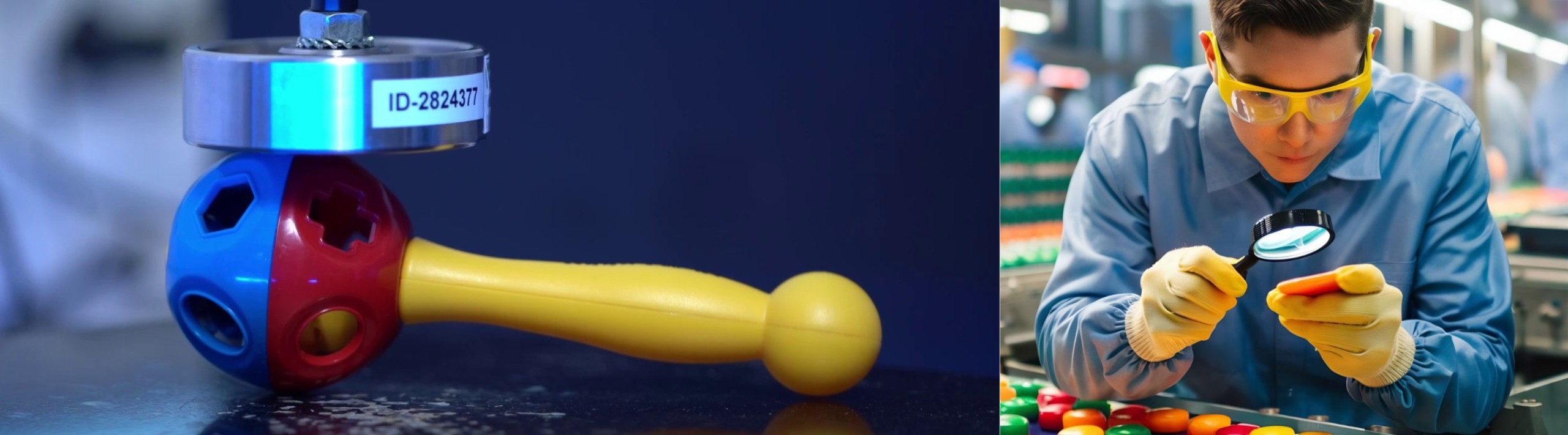
Our services support manufacturers and importers in preparing toys for EU market access through definition of applicable requirements, assessment of technical documentation, and coordination of conformity assessment activities.
Toy safety compliance requires evaluation of product design, materials, age grading, intended use, and applicable safety requirements.
Directive 2009/48/EC establishes the regulatory requirements for toys placed on the European market.
Plastic and wooden toys
Plush toys
Educational and activity toys
Ride-on toys
Electronic toys
Various toy components
The Directive defines essential safety requirements covering:
Assessment is typically performed against relevant harmonised standards and includes evaluation of design, materials, age grade, warnings, and test evidence.
The required testing scope depends on toy category, intended age group, and materials used.
Typical applicable business categories include medical device manufacturers, IVD manufacturers, contract manufacturers, sterilization providers, packaging providers, critical component suppliers, laboratories, calibration providers, logistics operators, and technical service organizations supporting medical device products and operations.
Confirmation of applicability under Directive 2009/48/EC, including review of toy type, intended age group, and definition of testing scope.
Evaluation of technical documentation, materials, warnings, and labeling to identify gaps and required testing.
Coordination of laboratory testing and support in addressing non-conformities where identified.
Preparation of documentation suitable for CE technical file and placing products on the EU market.
Age classification and intended use are key factors in determining the applicable safety requirements for a toy. They influence the selection of relevant safety standards, testing methods, warning labels, and risk assessment criteria.
Toys intended for younger children are subject to more stringent requirements due to increased risks associated with small parts, sharp edges, mechanical hazards, and material safety. The intended use of the product is also evaluated to identify foreseeable patterns of play and potential misuse.
Accurate age grading and intended use determination are essential for selecting the appropriate conformity assessment approach and demonstrating compliance with the Toy Safety Directive (2009/48/EC) and applicable harmonised standards.
A toy safety technical file typically includes a product description, design and manufacturing information, risk assessment, drawings and specifications, material information, test reports, user instructions, labeling details, and records demonstrating compliance with applicable requirements.
The documentation should provide sufficient evidence that the toy meets the essential safety requirements of the Toy Safety Directive (2009/48/EC) and applicable harmonised standards, including mechanical, physical, chemical, electrical, flammability, and hygiene requirements where relevant.
The exact documentation required may vary depending on the toy type, intended age group, materials used, and product complexity.
Yes, toy components and accessories may require assessment as part of the overall toy safety evaluation. Their safety impact is determined based on their function, intended use, materials, and potential hazards they may introduce.
Components such as batteries, electronic modules, cords, magnets, small parts, coatings, and decorative accessories may be subject to specific safety requirements and testing. In some cases, supporting documentation or test reports for individual components may be required to demonstrate compliance.
The extent of assessment depends on the product design and the applicable requirements of the Toy Safety Directive (2009/48/EC) and relevant harmonised standards.
Delays in toy safety compliance evaluation are most commonly caused by incomplete technical documentation, missing or inadequate risk assessments, and insufficient information regarding materials, components, or product construction.
Additional factors may include incorrect age grading, missing warning labels, non-conformities identified during testing, and the incomplete application of relevant harmonised standards. Delays can also occur when supporting documentation for components, chemicals, or supplier declarations is unavailable or incomplete.
A thorough review of product documentation and applicable requirements at an early stage can help identify potential gaps and reduce delays during the conformity assessment process.
Yes. Toys placed on the European market must comply with the requirements of the Toy Safety Directive (2009/48/EC) before CE marking can be applied.
Manufacturers are responsible for demonstrating that the toy meets all applicable safety requirements, including mechanical, physical, chemical, electrical, flammability, and hygiene requirements where relevant. This typically involves risk assessment, preparation of technical documentation, and testing against applicable harmonised standards.
Once compliance has been demonstrated, the manufacturer may issue the EU Declaration of Conformity and affix the CE marking to the product. The appropriate conformity assessment procedure depends on the toy type and the standards applied.